Thursday, December 2, 2010

Personal Narrative Draft

Here is my narrative so far. It is mostly just a vivid memory that I have, and I am not really sure (I have no idea) how to make it sound like it changed my life. I do consider it a significant moment though.

I shivered as I stood by the side of the pool, waiting for my heat in the 200 meter freestyle race. My first race. This was my very first swim meet since joining the Springville Seals swim team. The summer after 8th grade, I had been inspired to try competitive swimming by the stories of my many family members who were great swimmers. My grandma was a state champion in backstroke, and her brother could have been a world champion swimmer, but he switched to diving and went on to the Olympics. I figured I must have some pretty good swimming genes in me. I wasn't the most athletic, but I loved to swim, and I had taken swimming lessons my whole life, which made the swim team the obvious choice for a sport.

When I heard, "Swimmers, take your mark," I stepped up to the starting block and pulled on my goggles, my mind calm, my breathing steady. I knew that I probably wouldn't come in first, but that didn't bother me. I knew that how well I did would reflect how much training I had done. I was only a beginner, but at every practice I had done very well, always keeping up, and sometimes waiting impatiently for slower swimmers ahead of me as we swam lap after lap. I felt well prepared. I was focused, serene, and it was as though I could feel every stroke I had ever done imprinted into my muscles, the pattern of movement memorized by each body part. The echoing of every voice and splash in that indoor pool faded into the background as I knelt down and stared into the water below. I imagined how I would slice into the water on impact, creating as little resistance as possible. I continued to breathe deeply and my surroundings dissolved, leaving just me and the water.

I barely heard the whistle blow, but my body was ready to go. My fingers let go of the edge of the block, and my legs kicked off. In that split second where I was airborne, I pulled my arms straight in front of me, overlapping my hands, and dived into the water. I propelled myself to the surface and pulled my arm up out of the water. The movements were automatic; stroke, turn, breathe, kick, stroke, turn, breathe, kick. As I turned my head to breathe, I glimpsed the other swimmers, neck and neck with me. I knew I was doing well, and might have a chance of actually coming in first. I pushed myself a little harder, and pulled ahead slightly.

As I started into my second lap, that's when it happened. My chest suddenly tightened, and as I tried to breathe I sucked in water and began to choke, my throat burning from chlorine and physical exertion. I tried to compose myself and push onward, but I had upset my rhythm, my limbs flailing awkwardly for a moment. When I finally righted myself, the other swimmers were far ahead of me. I continued forward, determined not to come in last, but it was no use. My lungs burned and heaved, making me gasp for breath when I turned my head. I got more water in my mouth and had to spit it back out when my face went underwater again. My body felt heavy, as if I were wearing a thick, wet sweater, and I slowed way down. I realized that I still had two laps to go and my heart sank. I knew that no matter what, I was going to look pathetic, but if I could just finish, that would at least be something.

The other swimmers finished and climbed out of the pool, and there I was, half drowning as I struggled through each stroke and excruciating breath. My goggles had slipped a bit and water was seeping into my eyes. My head spun from lack of oxygen and I imagined myself sinking down to the bottom of the pool where I could slip into peaceful oblivion. But I forced my muscles not to relax until I finally finished and pulled myself out of the pool with shaking arms. I didn't let myself look at anyone. I just stumbled into the locker room, wrapped myself in a towel, and sobbed in disappointment and relief. That was the end of swim team for me.

Wednesday, December 1, 2010

Great Works Response: The Master's Hand


Historical Contextualization

“Christ Healing at the Pool of Bethesda” by Carl Heinrich Bloch is one of twenty three pictures painted for the Frederiksborg Chapel in Denmark. Bloch was considered one of Europe’s finest portrait painters and received many prestigious awards for his work. It took Bloch fourteen years to complete the collection of paintings for the Chapel. Bloch had been commissioned to illustrate the life of Christ through these paintings and they were to hang in the King’s Praying Chamber within the chapel.

These beloved depictions of the life of Christ can be found in the pages of Ensigns, on the walls of meeting houses, and the covers of church manuals. Bloch’s work has greatly influenced Latter-day Saint members’ idea of what the Savior must have been like

Critical Analysis

Bloch uses the contrast of light and dark to emphasize the idea that Christ is the light of the world and can bring peace and healing to those who believe in Him. Christ is the focal point of the painting in a brilliant white robe illuminated by some unknown light source, and His face shines with divine light. As he lifts the cover from the old, infirm man, His healing light begins to fall on the man. The crippled man has his hands raised in surprise at the kind face looking upon him. This man has probably been overlooked and ignored everyday by the people intent on curing their own illness, and no one has ever shown any concern for him until now.

The people standing behind Jesus are darkness. They seem to be talking to each other, questioning this man who has come and giving Him contemptuous looks. Perhaps they are in darkness because they are not followers of Jesus and do not receive His light. On the other side of the painting in the direction that Jesus is facing are people who are unaware of His presence in the moment, but will likely notice Him and believe in Him when they witness the miracle of the infirm man being healed. A small boy standing by his mother greatly resembles the boy in another of Bloch’s paintings, “Christ and Child.” The boy looks at the viewer as if to indicate that he is aware of what is going on in the foreground.

A red cap draws attention to its wearer: a man sitting beside the pool, gazing directly at the viewer of the painting. The expression on his face is hard to read. Perhaps he is giving a warning stare; He wants to get to the water first, and does not want anyone to stop him from being healed. Or, as I prefer to think, he is inviting the viewer to notice the miracle is going on beside him and to come be healed by Christ. Either way, the man’s gaze includes the viewer as a participant in the painting as well, making it a much more personal experience.

One interesting comparison that can be made is between the pool of Bethesda and Christ. One is healing water and one is the Living Water. While the pool is the reason for which all the people have gathered, only a small portion of it can be seen in the lower right-hand corner of the painting. One could say that the pool represents worldly needs and desires. All the people in the painting have the goal of making it to the pool first to have their needs satisfied. But if only they turned instead to Christ, who is standing in their midst, they could all be healed. Unlike the “worldly” pool that can only satisfy their temporal needs to a degree, Christ the Living Water can satisfy them spiritually so that they “never thirst again” (John 4:14).

Personal Reflection

As a member of the Church, I have been familiar with Carl Bloch’s paintings my whole life. But because I saw them everywhere, I took them for granted. I never really noticed the paintings, let alone wondered who painted them.

However, seeing the original paintings was like seeing those images for the first time. They were so much bigger, the details were clearer, and the colors deeper than the copies I had seen before. It was fascinating to not only see the original familiar face of the Savior that I had seen so many times before, but to actually see the texture of the brushstrokes as proof that someone had actually painted these beautiful paintings. For the first time I realized that these paintings could only be created out of love and devotion to the Savior. I could see Bloch’s careful consideration in the way that he depicted Christ in his paintings. I could feel the spirit so strongly as I sat in the exhibit and I felt Carl Bloch’s testimony of the loving nature of Christ through his exquisite paintings.

Saturday, November 20, 2010

Sarcasm

As I have explored the internets, I have come across something very interesting: the use of sarcasm. Sarcasm is something you come across every day in the real world, and is the basis for a large amount of humorous things that people say.

But when it comes to the written word, including what is published online, using sarcasm effectively is very difficult. Even for a talented writer who can invoke many complex emotions in his reader, sarcasm is generally avoided because it requires hearing tone of voice to be correctly interpreted.

However, as I was reading some blogs online, I discovered that many humorous writers have devised a simple way to bypass all the confusion of written sarcasm. They call it the "sarcasm hand." Whenever the writer say something sarcastic, at the end of the sentence they write in parentheses, "sarcasm hand raised."

This phrase is more often than not manipulated so it can describe the level of sarcasm used. I shall try to demonstrate.

Sardines are SOOO good. (Sarcasm hand.)

I can't wait for finals week! (Hand raised so high my fingers just brushed the underside of a flying commercial jet.)

The Twilight series is extremely well written, the characters are well developed and consistent, the plot keeps you guessing, and the relationships are a good model of what a healthy relationship should be like. (Sarcasm hand raised so high I just made a shadow puppet on the face of Pluto.)


Wednesday, November 17, 2010

Don't Sweat the Small Stuff

I would like to share a book that I have found very helpful in my life, especially when I am feeling down or need some motivation. It is called "Don't Sweat the Small Stuff (for Teens)" by Richard Carlson. It gives wonderful advice for dealing with stressful situations that young people often face.


One thing that I love about this book is that it has sort, concise chapters for each topic discussed. Whenever I feel stressed, I just pick up the book, flip to a chapter, and read. It usually doesn't even matter which chapter I read, I almost instantly feel better. Carlson has a voice of understanding, yet he effectively gets his reader to think rationally, no matter what the situation may be. His short chapters make it easy to read, and he uses the perfect mixture of information, compassion, and humor to get his reader excited about life again.

This book has helped me through some hard times, and I highly recommend it to anyone who is struggling, whether it be with relationships, homework, a bad mood, insecurity, or just about anything else.

Friday, November 12, 2010

Excerpt from "The Choice" by Arbinger Institute

Self-Betrayal

As a person, I know what it means to be a
person. I have a sense of what people need.

For example: I see a person in need, and 
I feel to help.


My responsiveness to others' needs is my 
deepest sense of what is right.


I can resist this responsiveness toward 
others' needs.


If I do, I betray my deepest sense of what 
is right.


Betray my deepest sense of what is right
and I betray myself.


Betray myself and I do wrong. Do wrong
and I seek to be justified. I begin seeing a
world that makes the wrong seem right.


Example: My child cries in the middle of
the night, and I feel to get up and tend to
her before my spouse wakes up.
But I don't.


I now say:


"I got up last time."


"My spouse is not as busy as I am."


"My spouse is probably feigning sleep."


Another example: I obtain information
that would help a coworker and I feel I
should share it. But I don't.


I now say:


"This person doesn't help me."


"This person is too dependent on others already."


"I worked hard for this information."


The people I felt to help now seem
blameworthy.


I feel justified in not helping.


But did they seem blameworthy when I
felt to help?


Why do they seem blameworthy now?


Betray myself and I seek to be justified by
blaming others. I become resistant to them.


People Or Objects


So I betray myself, and people to help
become objects of blame.


Instead of people with their own lives, I
now see others as obstacles in mine,


or as vehicles to be used for my purposes,


or as irrelevancies that offer me no
advantage.


Consider:


When I felt to get up and tend the baby
before my spouse woke up, was my spouse
a person or an object to me?


And how was I seeing my coworker when I
felt I should share the information I had
obtained?


Compare:


How did I see my spouse and my coworker
after I betrayed my sense of what I
should do for them?


Responsive is who I was.


Resistant is the way I made myself in
self-betrayal.


Reducing people to mere objects is the
way I resist them.

Saturday, November 6, 2010

Wisdom from Lewis Carroll

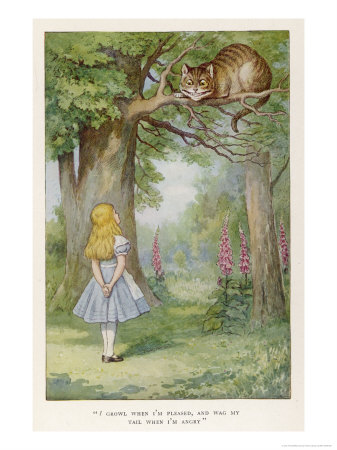
Yesterday I read an excerpt from Lewis Carroll’s “Alice in Wonderland.” It was about Alice’s encounter with the Cheshire cat. When the cat pointed out which way the Mad Hatter and the March Hare lived, Alice exclaimed that she didn’t want to be around mad people. “Oh you can’t help that,” Said the Cat: “we’re all mad here.”
No matter where we go, there will be “mad” people. We will meet people who are disagreeable, strange, and antagonistic. We can either be offended by them, or we can choose to give them the benefit of the doubt and not let them bother us.
At work there is a girl who is sometimes rude to me. Usually I would avoid her and never spoke to her. But today I decided to smile and say hello to her when I went into work. And to my surprise, she smiled and said hello back. I may never know why she acts the way she does sometimes, but it doesn’t mean I can’t be nice to her.

Tuesday, November 2, 2010

Pattern for Prayer

In my Book of Mormon class Sister Halverson talked about a pattern of prayer as outlined by Elder Bednar. He prays in the morning to ask Heavenly Father what he can do that day to improve himself and asks for guidance throughout the day. Then he prays in the middle of the day to give a “progress report” and seek further direction. At the end of the day he would pray to express gratitude for all his blessings and to asses the day to figure out what went well and what did not.

I tried praying like this yesterday I found that my prayers were more meaningful and I was more conscious of how I behaved throughout the day. I will use this method of prayer more often.