Saturday, November 20, 2010
Sarcasm
Wednesday, November 17, 2010
Don't Sweat the Small Stuff

One thing that I love about this book is that it has sort, concise chapters for each topic discussed. Whenever I feel stressed, I just pick up the book, flip to a chapter, and read. It usually doesn't even matter which chapter I read, I almost instantly feel better. Carlson has a voice of understanding, yet he effectively gets his reader to think rationally, no matter what the situation may be. His short chapters make it easy to read, and he uses the perfect mixture of information, compassion, and humor to get his reader excited about life again.
Friday, November 12, 2010
Excerpt from "The Choice" by Arbinger Institute
I feel to help.
My responsiveness to others' needs is my
deepest sense of what is right.
I can resist this responsiveness toward
others' needs.
If I do, I betray my deepest sense of what
is right.
Betray my deepest sense of what is right
and I betray myself.
Betray myself and I do wrong. Do wrong
and I seek to be justified. I begin seeing a
world that makes the wrong seem right.
Example: My child cries in the middle of
the night, and I feel to get up and tend to
her before my spouse wakes up.
But I don't.
I now say:
"I got up last time."
"My spouse is not as busy as I am."
"My spouse is probably feigning sleep."
Another example: I obtain information
that would help a coworker and I feel I
should share it. But I don't.
I now say:
"This person doesn't help me."
"This person is too dependent on others already."
"I worked hard for this information."
The people I felt to help now seem
blameworthy.
I feel justified in not helping.
But did they seem blameworthy when I
felt to help?
Why do they seem blameworthy now?
Betray myself and I seek to be justified by
blaming others. I become resistant to them.
People Or Objects
So I betray myself, and people to help
become objects of blame.
Instead of people with their own lives, I
now see others as obstacles in mine,
or as vehicles to be used for my purposes,
or as irrelevancies that offer me no
advantage.
Consider:
When I felt to get up and tend the baby
before my spouse woke up, was my spouse
a person or an object to me?
And how was I seeing my coworker when I
felt I should share the information I had
obtained?
Compare:
How did I see my spouse and my coworker
after I betrayed my sense of what I
should do for them?
Responsive is who I was.
Resistant is the way I made myself in
self-betrayal.
Reducing people to mere objects is the
way I resist them.
Saturday, November 6, 2010
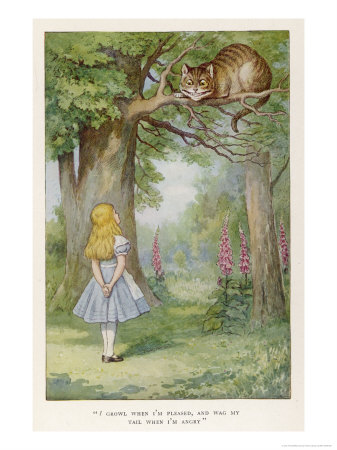
Wisdom from Lewis Carroll
Tuesday, November 2, 2010
Pattern for Prayer
In my Book of Mormon class Sister Halverson talked about a pattern of prayer as outlined by Elder Bednar. He prays in the morning to ask Heavenly Father what he can do that day to improve himself and asks for guidance throughout the day. Then he prays in the middle of the day to give a “progress report” and seek further direction. At the end of the day he would pray to express gratitude for all his blessings and to asses the day to figure out what went well and what did not.
I tried praying like this yesterday I found that my prayers were more meaningful and I was more conscious of how I behaved throughout the day. I will use this method of prayer more often.
Tuesday, October 26, 2010
Whose decision is it?
One important aspect of decision making is determining who the decision maker is and acting accordingly. If the decision is yours to make, you can accept advice from other people, but you should keep in mind that the decision is still yours to make. You can’t always please everyone with a decision you make, so you must simply say, “Thank you for your input, I will go make my decision now.”
Most of my life I have made decisions to please my parents. Sometimes this has resulted in me being unhappy with the consequences. I decided that in the future I would keep in mind that if the decision is ultimately mine, I wont make a decision simply to please my parents. I used this in a small decision last week when I had to choose between getting my homework done right away or going to hang out with friends. My mom strongly encouraged me to hang out with my friends since I had not seen them in a long time. I thanked her for her advice, and then instead of leaving right then to see my friends, I called one of them and scheduled another time to get together and I was able to finish my homework. I am glad that I remembered that the decision was mine to make because it led me to make a better decision that benefitted everyone.